Good morning, Armchair Army,
Welcome to today's edition of The Armchair Analyst, a 5-minute daily update on the ASX life-sciences sector.
Disclosure: Imunexus is a “Watchlist Company”. Imunexus has paid Armchair Analyst Media Pty Ltd to produce this content. Read this content with the relationship in mind.
This information is general in nature and does not constitute personal financial advice.
When I was 16, my favourite video game was Call of Duty.
(Too many hours sunk into it)
Each time I levelled up, I improved my weapon.
New attachments, new perks, new powers.
This is how Imunexus builds upon existing antibody drugs to make them better.
Better targeting. Better half-life. Better activation.
Better.
The base antibody is the gun.
Normal… Boring… You get this on Lvl.1
The “Imunexins” are the attachments and perks you can add to your character as you level up.
Faster aim. Better control. More power…
Together, they make a “Bispecific”.

How many attachments does Imunexus have?
16 billion.
… yes, with a B.
That is the total number of Imunexins in the library.
Now take that number and multiply it by “all the antibody drugs ever made”…
THAT is how many weapon combinations there could be.
Provided that the combinations worked… The game won’t let you put a grenade launcher on a sniper rifle, for example.
Founded by George Kopsidas and backed by Mesoblast’s (ASX: MSB | $2.7B) founder, Silviu Itescu, Imunexus is a pre-IPO biotech developing bispecific and multispecific drugs.
(looking to list this year)
Bispecifics are drugs with TWO targets.
… and they have the “potential” to build the perfect weapon against disease.
The challenge is finding the right combination for the right disease… and making sure the pieces fit and work together.
Last month, Roche signed TWO billion-dollar bispecific deals.
… not for an existing drug.
But to find a new drug.
FIRST…
Roche signed a deal with Dualitas Therapeutics.
US$36.5M upfront and up to US$1 billion in milestones.
The goal was to screen over 300,000 novel bispecific combinations to find new treatments for immunology and inflammatory diseases.

(Source: Fierce Biotech)
SECOND…
Roche’s Genentech signed a deal with Earendil Labs.
US$55M upfront and more than US$1.5 billion in milestones (plus royalties)
To discover and develop multiple cancer bispecifics.

(Source: Biopharm International)
Last month, BioCentury’s podcast hosts labelled bispecifics as the “technology to watch” after reviewing 221 Big Pharma deals from the past year.
Here’s the quote at the 18-minute mark…
"The one that stands out is bispecifics. Year over year, this is the one that has been increasing the most, and that has continued to increase even when deals were down last year."
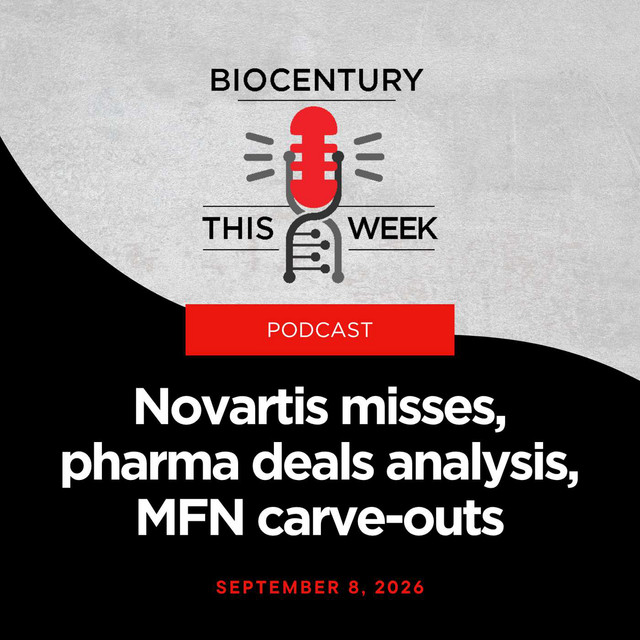
Right now, Big Pharma is in an arms race for bispecific platforms.
Paying for discovery, not just drugs.
IF Imunexus’ modular approach to bispecifics delivers drugs that work…
AND can be manufactured reliably at scale…
THEN it has a “holy grail” worth chasing.
A repeatable Big Pharma licencing business, with its bispecific platform at the centre.
Multiple Sclerosis is its first major proof point.
… and it already has a non-exclusive licence with a “global biopharmaceutical company”.
Imunexus, my first Watchlist Company.

But first…
The Pulse Check
Control Bionics (ASX: CBL) AGM presentation provided some updates on its commercial activities. (CBL, Armchair Pick, Held)
🪑 Buried on Page 22 is the fact that the major NFL team “Kansas City Chiefs” are currently using CBL’s product:

80 organisations engaged and 30 live trials is a big pool of potential customers.
Some good information on page 25 as well about what CBL has learned so far (including about the different sales processes/cycles for each organisation)
Nice update.
Orthocell (ASX: OCC) published results from a case series of prostate surgeries using Remplir, its nerve repair device. 80% urinary continence and 75% erectile function recovery. (OCC)
🪑 Very good results, and should drive adoption in the US.
(This is a favourite of Surgeon Dan, a urologist who uses the Orthocell product in his practice).
Nyrada Inc. (ASX: NYR) receives FDA feedback for its Xolatryp® cardioprotection program, “no major issues”. US IND submission in H1 2027. (NYR)
🪑 Milestone ticked.
Proteomics International Laboratories Ltd (ASX: PIQ) completes refinement and independent validation of its blood test for endometriosis. (PIQ)
🪑 Probably easiest to show the results in this table. Strongest sensitivity for “severe” Endo, with 68% sensitivity in detecting Endo at “all stages”.

Good results.
Cleo Diagnostics (ASX: COV) begins analytical validation of its Ovarian Cancer Test, moving toward an FDA 510(k) submission in H1 2027. (COV)
🪑 Off to the races.
PainChek Limited (ASX: PCK) expands its contract with SABRA from 2 to 23 US communities for its pain assessment and monitoring application in the US assisted living sector. (PCK)
CurveBeam AI (ASX: CVB) secures approval for its HiRise CT scanner in China, triggering a A$1M equity investment and allowing commercial sales to begin in the region. (CVB)
🪑 Big milestone ticked.
Pretty sure that this equity investment is set at $0.405 per share… stock trades at $0.020.
Nice premium.
NeuroScientific Biopharmaceuticals (ASX: NSB) receives FDA feedback on its Phase 2 Crohn's Disease trial design, with only one outstanding matter to be addressed in the manufacturing controls. (NSB)
🪑 Milestone ticked.
Microbiome testing company Tiny Health secures US$33M at an undisclosed valuation. (Fierce Biotech)
🪑 I think that’s the entire market cap of ASX-listed Microba.
Good value peer comp.
Sabi, an AI startup building a “mind-reading baseball cap”, has raised US$50 million at a US$600 million valuation. (Forbes)
🪑 More evidence that consumer wearables tech is catching investor attention in the US.
Vitura Health Limited (ASX: VIT) reports Q1 FY2027 revenue up $1.7M (4.8%), EBITDA up 197.5%, and operating expenditure down 9.5%. (VIT)
🪑 Much better quarter from VIT.
Things turning around?
Cogstate (ASX: CGS) reports $25.1M in net sales contracts for Q2 2027, up 38% to $31.7M, driven by five Phase 3 trial wins in mood disorders. (CGS)
🪑 Good quarter from CGS. The market liked this one.

For over fifty years, drugs had one target.
ONE pathway to block…
ONE function to inhibit…
ONE receptor to activate…
The foundation of this was monoclonal antibodies.
A lab-made, Y-shaped protein that mimics natural immune system antibodies to target specific cells, proteins, or antigens in the body.
It is the foundation of trillions of dollars worth of drug sales.

In 1975, Georges Köhler and César Milstein published a method for producing them in large quantities.
And yes…
They did win the Nobel Prize.

Humera… the best-selling drug of all time?
A monoclonal antibody.
Keytruda… the $31 billion behemoth.
A monoclonal antibody.
Six of the top-selling drugs of 2025 were monoclonal antibodies:

… and then came along the “Bispecifics”.
Bispecifics are enhanced versions of monoclonal antibodies that don’t just hit one target… but two.
Block one pathway… AND activate another.
Activate one function… WHILE inhibiting a receptor.
Blincyto was the first approved bispecific in the US in 2014.
It pulls the immune cell towards the cancer, while activating it as well:

THAT is the potential of the bispecific platform.
… and these are “platforms” in the truest sense.
The underlying “technology” or “innovation” lies in how we choose targets and whether we can manufacture the new products.
How does the tech work?
Bispecifics look so simple…
Start with two Antibodies → Stitch them like Frankeinstien → Get New Drug
Right…?

Wrong.
Antibodies are NOT like the 2D images above…
They are complex 3D shapes.
Which means that changing them can affect how they fold, bind, and behave.

The challenge isn’t JUST finding the targets.
(which is still a challenge)
It’s getting a molecule that can act on both…
Fold correctly and be manufactured reliably.
Most platforms build the whole molecule from scratch.
They write the DNA for a new, complex protein, put it into cells, and hope it folds into the right shape.
Sometimes it does.
(This is where the big winners are created)
Sometimes it doesn't…
(You’ve got scrambled eggs… back to square one).
To address this, some bispecific platforms use brute-force AI/Machine learning tools to predict which target combinations will work together.
(This is done from a “library” of near-infinite combinations of targets)
Imunexus takes a modular approach.
Like the other platforms, it has a “library” (of Imunexins).
But its difference is that it is NOT a Frankenstein of two antibodies at the top binding sites.
It adds “imunexins” to the bottom.

This preserves the therapeutic functions of the original antibody, enzyme, or cell while adding new, novel properties.
So far, the Imunexin platform has created different imunexins can:
Activate the immune system (engagers)
Suppress the immune system
Increase how long the drug remains in the body
Target different diseases, viruses and other cells
… and much, much more.
How to Build a “Platform Business”
All drugs have an element of being a platform technology…
They can show promise across different applications, indications, and targets.
The problem is that each indication can take 15+ years.
… and early-stage biotech companies have limited capital to deploy.
So they have two choices.
Either…
A) Develop a lead indication built on the platform.
An easier story to understand, but it concentrates the money and investment case on one asset.
OR
B) Build the business platform first.
Potentially lower capital costs, but the risks shift towards the company’s ability to find partners for its technology.
At this early stage of Imunexus’ journey, it will take a HYBRID approach.
DEVELOP its “platform” and lean on existing and new partners for further financing.
WHILE advancing its lead asset in Multiple Sclerosis (the lead asset).

This playbook is copied from Merus, a bispecific discovery company Genmab acquired for US$8 billion in 2025.
The Merus story…
Merus listed on Nasdaq in 2016 with its bispecific platform, Biclonics.
By 2021, it had four proprietary or co-developed assets in human clinical trials.
Some were partnered.
But Merus also advanced its own candidates, using its own capital alongside partner funding.
WHILE getting paid to use the platform for discovery.
In January 2021, it signed a deal with Eli Lilly to discover up to three T-cell-engaging bispecific therapies using Biclonics.
US$40M up front, plus a US$20M equity investment.
Up to approximately US$1.6 billion in milestones across the three programs.
Merus would lead discovery and early research, with Lilly responsible for subsequent development and commercialisation.
In 2025, Genmab acquired Merus in a transaction valued at approximately US$8 billion.
Lesson?
Platform companies like Merus can be paid to advance drugs in the “discovery” stage and use the funds to finance their own asset development.
But it all hinges on the platform's quality.
Why would big pharma pay Imunexus to develop bispecifics?
The idea is for a big pharma company to bring its own drug or development brief and pay Imunexus to apply the technology.
Why would they do this?
FIRST, extend a drug’s commercial life.
Big pharma faces a major patent cliff (US$220 billion in drug sales are coming off patent in the next five years).
If Imunexus can develop better versions of existing drugs, it could extend the value of Big Pharma's core IP and business.
SECOND, rescue promising drugs that fell short.
There are LOTS of drugs left on the cutting room floor that show lots of promise.
A bispecific could fix these drugs' limitations (like poor efficacy, poor targeting or short half-life), provided the targeting capabilities are strong.
THIRD, discover new drugs.
Combine therapeutic functions that a single-target medicine cannot deliver alone.
The super drug.
What does Imunexus need to prove before it can sign a deal?
Big Pharma wants to see…
Animal studies.
Toxicology work.
CMC (chemistry, manufacturing and controls).
Show that the molecule is stable and can be manufactured at scale.
THEN, maybe a human safety trial.
But honestly.
Big pharma is paying up for bispecifics at the discovery and pre-clinical level.
Why?
Because these are KNOWN targets, including targets already validated by existing drugs.
That bit is largely de-risked.
What isn’t de-risked is whether the Frankenstein bispecific is stable and works.
How I look at a platform business model
Companies pursuing the “platform” business model need three things.
FIRST, the platform has to be good.
SECOND, the company needs the ability to secure commercial partners.
THIRD, incentives must encourage those commercial partners to advance the platform.
Also… it requires people.
People with deep networks in big pharma companies and an understanding of what they want.
People who can close a deal.
One of Imunexus's key priorities is finding this person, as their ability to help licence this technology could be a “company maker”.
So far Imunexus has signed two deals:
FIRST, a non-exclusive licence with a “global biopharmaceutical company” for imunexin-enhanced stem cells.
SECOND, a co-development agreement with the Baker Heart and Diabetes Institute for multiple sclerosis.
Develop the Platform with a “lead target”
This was Earendil Labs' playbook.
It sold two bispecifics to Sanofi for US$125M upfront and US$1.72 billion in development and commercial milestones.
The two drugs target autoimmune and inflammatory bowel diseases.
… Both in the preclinical stage.
Then Sanofi came back nine months later for the platform.
Another US$160M in upfront to use “Earendil’s platform” to identify multiple autoimmune and inflammatory disease programs.
Each drug that Earendil developed… sold for more than US$100M upfront.
This is the pathway Imunexus has outlined for IMX39 in multiple sclerosis.
Imunexus does early clinical development… then finds a partner to buy the bispecific.
THEN, license out the platform alongside.
(that’s the dream anyways)
So, how does Imunexus pick the right target?
Imunexus has a six-point plan to pick
Market size: Is the market big enough?
Commercial landscape: Is there an unmet need? What is the commercial landscape?
Development de-risking: Ask, why did the original antibody fail? Is it fixable?
If it was a poor target = not worth developing.
If it was a good target, but poor potency (for example) = could have potential.Imunexin fit: Can an imunexin fix the problem directly, without further engineering?
Partner suitability: Is there a suitable partner to take it over?
Regulatory advantage: Orphan drug status, unmet need, fast-track potential.
Multiple Sclerosis: Imunexus’ lead asset
MS is a debilitating autoimmune disease in which the immune system attacks its own nerve cells in the brain and spinal cord.
Imunexus is developing a novel solution, in collaboration with the Baker Heart and Diabetes Institute, that may restore damaged myelin around nerves.
(Let’s see how this fits into Imunexus’ OWN target selection…)
Market size
The global MS market is worth more than US$30 billion.
Around 3 million people globally live with MS, with women accounting for roughly 70% of cases and the average age at diagnosis being 32.
Big market. Tick.
Commercial Landscape
Existing MS drugs DO work.
Roche, Novartis, Biogen, Sanofi and Merck already have established MS medicines.
They reduce immune-driven inflammation, helping prevent relapses and slow disability progression.
But… no drug on the market repairs damaged myelin, the protective coating around nerve cells.
IF a drug could control inflammation and repair damaged myelin, that would be a meaningful advancement beyond what existing treatments deliver today.
Development Derisking
The Baker Heart and Diabetes Institute had been developing the base molecule for 10 years.
It has consistently shown promising results in animal studies, with genuine nerve-repair potential.
BUT, the challenge has been directing its activity to the right disease site and keeping the molecule active in the bloodstream (its half-life) long enough…
The short half-life meant that, if it were to be commercialised, it would require multiple injections a day.
Not practical.
ALSO, it had low potency.
The drug had only ~15% effect because it wasn’t getting directly to the target.
So there were flaws.
But the target (and mechanism of action) was de-risked.
Finally, the base molecule lacked patent protection, which would have made commercialising the drug difficult.
Does the Imunexin improve things?
YES.
IMX39 is being developed to preserve those therapeutic functions while improving its half-life and selectivity for the disease site.
FIRST, the base molecule is an enzyme that reduces the initial pro-inflammatory signal that causes MS.
SECOND, an imunexin that brings the enzyme to the target = Increases potency
THIRD, an imunexin that increases the half-life of the enzyme 60-fold = Commercial Viability
A modified enzyme with a three-pronged attack.
So far, the pre-clinical data have been promising.
The mouse on the LEFT is healthy.
The mouse in the MIDDLE has MS.
The mouse on the RIGHT has MS with IMX39.

Partnering Suitability
Multiple organisations have established MS franchises.
That creates a pool of potential partners who already understand the disease and its commercial market.
(and some competitive tension for an improved drug on the market)
Regulatory Advantage
Repairing damaged myelin remains an unmet need, with no approved treatment specifically designed to do this.
That could support an expedited development case if IMX39 demonstrates meaningful benefits in people, but it’s not an advantage we can bank yet.
Other Targets in the Pipeline
Mesenchymal Stem Cells
Imunexus has a non-exclusive licence to develop three imunexins for “next-generation MSCs”.
This deal with a “global pharmaceutical company” aims to create stem cells with expanded function and targeting.
Small cell lung cancer
A T-cell-engaging bispecific antibody for small cell lung cancer, an unmet medical need.
Same broad idea as Blincyto.
Bring the immune cell to the cancer cell.
(This is the one I’m probably most bullish about)
Gaucher’s Disease
An enhanced enzyme replacement therapy for Gaucher’s disease.
The company says the existing enzyme treatment doesn’t last long in the body, so it has added a half-life-extending imunexin.
An existing treatment PLUS an attachment designed to extend its half-life.
Fits the “unmet need” brief.
Other targets
I expect the company to announce more bispecific targets after the IPO.
What is the IPO pricing and raise?
Imunexus is raising $12.0 million at 35 cents a share.
Pre-money valuation: $22.4 million; market cap at listing: $35 million.

The majority of the capital will fund the Multiple Sclerosis Phase 1/2a clinical trial.
(Around 43%)
A successful trial here will do two things.
FIRST, it will validate Imunexus’ “platform” and its ability to develop multi-specific drugs.
(probably the most part)
SECOND, strong results may put Imunexus into a position to licence the drug.
Key Risks: What could go wrong?
Platform Execution Risk
The whole “platform first” model rests on doing deals.
Right now there's one pharma platform deal, the stem cell licence, which is non-exclusive and has no disclosed terms.
The second deal is a co-development deal in which Imunexus shares development costs.
Currently, there is a clear gap in the Imunexus team…
A US-based dealmaker with the networks to sign deals like the ones Meurs and Erendil secured.
I suspect this to be a key priority for the company once it IPOs.
IPO Liquidity Event Risk
For any IPO, you need to determine if it is a liquidity event or emergence event.
The company priced the IPO with an Enterprise Value of $22 million.
… which is probably about right for where the company is in its development stage, versus its potential to become a frontier bispecific platform.
Target Register Risk
The funds primarily support the MS asset.
While the company is positioned as “platform first”, the fund allocation is more akin to a single-asset company.
This means much of the company's value will naturally hinge on the MS asset and its potential.
The Armchair Take
Right now there is an arms race for bispecific platforms.
Big pharma is paying hundreds of millions of dollars just on discovery.
Not a drug.
Not a molecule.
Discovery.
That is the power of the bispecific platform.
A repeatable Big Pharma licencing business, with a handful of lead candidates at the centre.
Still, it is early days.
Much of the success will hinge on the company’s ability to secure licencing deals.
But it already has TWO…
One is with a “global pharmaceutical company”.
So… what’s the bet?
IF Imunexus’ modular approach delivers drugs that work AND can be manufactured reliably at scale, THEN it has a “holy grail” worth pursuing.
I’m looking forward to seeing this company on the list, hopefully before Christmas.
Big thanks to George Kopsidas and Philippa Lewis for sharing the Imunexus story.
See you all tomorrow,
The Armchair Analyst
What is an armchair pick?
An Armchair Pick is an invite-only spot I reserve for my highest-conviction investment ideas.
It's a paid arrangement, but to align myself, I only take my fee in shares - half escrowed for 6 months, half for 12.
It is general commentary only, not personal financial advice or a recommendation to buy, sell, or hold. Always see the disclosure at the top of the article and do your own research.